Review: Giles Robson – Nine Blues Originals
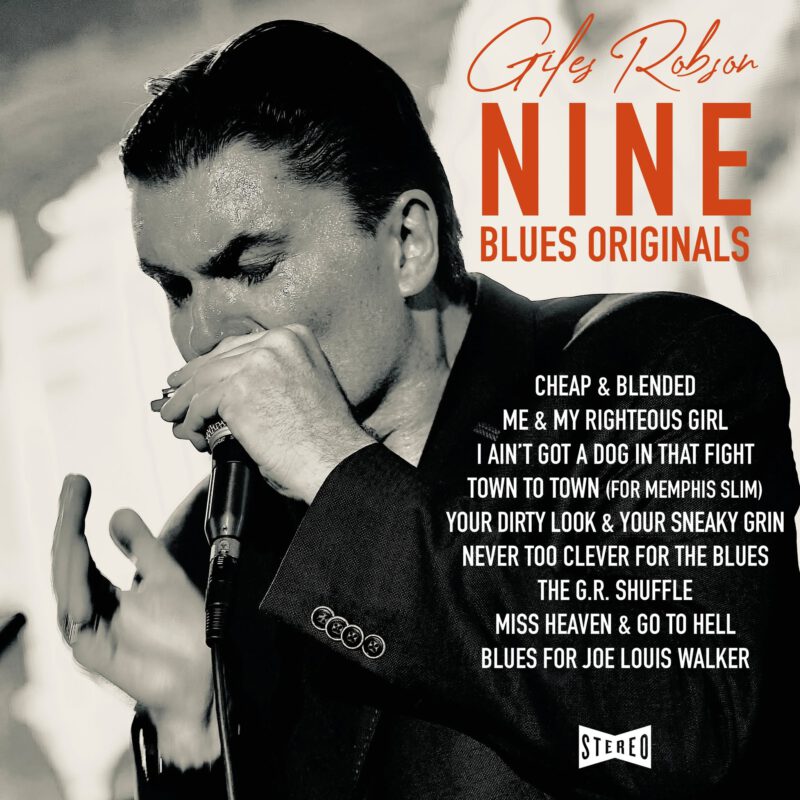
Giles Robson – Nine Blues Originals
Format: CD – Vinyl LP – Digital / Label: Independent
Release: 2026
Text: Pascal Wilhelm
His 13th release by my count (full albums, singles and EP’s on Spotify). Nine songs, showcasing Giles’ songwriting and harmonica chops in an intimate duo setting with the renowned Manny Frizzotti on acoustic and resonator guitar. Two of the originals were previously recorded with a full band (G.R. Shuffle and Your Dirty Look & Your Sneaky Grin). Arnaud Fradin (Mojo Hand Studios, Nantes) mixed and mastered the album. Giles’ former duo album with John Primer contained ten Chicago blues classics, this time it is all original material. Obvious question is where the songs come from.
How do you write your songs, Giles? For example Cheap & Blended and I Ain’t Got A Dog In That Fight. How did they come into existence?
“I usually start with a line that I’ve heard or read that sparks my imagination and relates to life experiences that I’ve lived or can relate to. It can be a line that either I’ve heard someone use or I’ve used, or even something in an old song. For example “Ain’t Got A Dog In That Fight” was a phrase my wife used once about a situation and set my imagination going and “ “Cheap & Blended” was inspired by touring in Spain years ago and seeing all of the imported cheap and blended Scotches on sale.”
With original blues songs, I tend to think in terms of three main dimensions of quality. The first is lyrical originality. Blues operates within a fairly well-defined set of themes and conventions, which makes it difficult to write lyrics that feel both authentic and genuinely fresh. The best writers manage to bring something new to familiar territory. The second dimension is song structure. Given the constraints of the traditional three-chord form, how much variation can be introduced without straying too far from the genre’s core identity? Striking that balance is an important part of the craft. The third dimension is the groove—the rhythmic feel and momentum that drive the song. In my view, the strongest blues songs excel across all three dimensions. Naturally, there are many other elements that affect the overall quality of a recording: vocal performance, instrumental playing, the strength of the solos, and the production itself. But if we focus on the song rather than the performance, these three dimensions seem especially important. Giles’ songs are particularly strong lyrically, while their structures remain largely rooted in tradition. The remaining question is the groove: how distinctive and compelling is the rhythmic feel that underpins the music?
On first listening to the album, I noticed that Manny Fizzotti plays purely rhythm guitar and no solos, Is there a reason he didn’t have any solos? Or is it all about the groove?
“Manny’s role is essential and him playing strictly rhythm was a deliberate creative decision. With blues it’s essential to establish the rhythm and the groove right at the beginning and hold it there till the end of the song. Blues is a cyclical “Looped” trance music like funk, a “Fixed and Variable” music model – where you have a static and solid foundation and variable elements like singing and a lead instrument on the top of this.
With a duo format like this with no bass, drums or second guitar and especially on a recording as soon as the guitar takes the solo the song can suddenly sound empty and you lose your strong foundation and the intensity of the groove and then you have to reestablish the rhythm and the groove after the solo and for the rest of the song. So guitar solos in this format can often break the spell. What Manny is doing across the album might sound simple but it’s actually highly accomplished, subtle and is an essential backbone to the whole sound and he really shines. I was greatly inspired by two of Sonny Boy Williamson’s duo recordings with the great Hubert Sumlin in Europe in the 1960s – “I Got To Cut Out” and “I’m Trying To Make London My Home”. Hubert Sumlin doesn’t solo but, like Manny, keeps the groove and is really sensational. You just want to hear the tracks again and again!“
Can you tell us more about your approach to singing the blues as an Englishman?
“Well, American English and UK English are incredibly close as English is both our country’s first language and a lot of the vernacular English from the USA has actually passed into everyday conversational English in the UK and is used by people throughout society. I am deeply influenced by and respect American blues singing and songwriting just like other UK artists before me like Mike Jagger, John Lennon, Paul McCartney, Van Morrison and contemporary UK stars like Ian Siegal and try my best to sing it well and write lyrics inspired by the way blues songs work lyrically. I’m inspired on a daily basis when I listen through the huge amount of historical blues recordings from the USA and it’s a deep and inspiring music. I’ve really had a strong and positive response to my singing when I’ve performed in Mississippi, Chicago and Memphis and also from American performers I’ve worked with such as Johnny Rawls, Thornetta Davis and John Primer so hopefully I’m doing something right – I’m constantly working on it!”
I’ve had the honour to perform with you on stage and I was impressed by your showmanship, your ability to captivate an audience and to push a band and its players to the limits of their abilities. When listening to this album, I noticed there is some inventive harmonica playing on for example, Town To Town and Your Dirty Look. How do you come up with this stuff?
“I try to listen to as much different music as possible to keep my ears and imagination wide and also many different instruments and try to be as inventive as possible but still keep that blues feeling. It was always taught to me by great artists like Joe Louis Walker to try and create your own style and not play cliché stuff. The upper register of the harmonica is very much underused but it’s very defined like the upper register of a piano and I like to incorporate that part of the instrument into my playing and style. It extends the melodic range of the instrument, adds a great contrast to the lower end and audiences have picked up on the delicate feel of the upper end.”
I would especially recommend this album to aspiring harmonica players. The stripped-back duo setting allows listeners to concentrate on Giles’ solo work and gain a clearer sense of his approach to the instrument. Nine songs (just like ten or seven) are the right number for an acoustic blues album—enough to feel substantial without overstaying its welcome. ‘Nine Blues Originals’ delivers a thoroughly satisfying listening experience from a sincere and authentic artist whose deep respect for the blues tradition shines through in every track.
Go check it out!
Tracks:
01. Cheap & Blended
02. Me & My Righteous Girl
03. I Ain’t Got A Dog In That Fight
04. Town To Town (For Memphis Slim)
05. Your Dirty Look & Your Sneaky Grin
06. Never Too Clever For The Blues
07. The G.R. Shuffle
08. Miss Heaven & Go To Hell
09. Blues For Joe Louis Walker
Website: https://gilesrobson.com/